Driveway Apron Replacements With City Street Projects
Street project coming to your block? Learn what happens to driveway aprons, your options with the city vs. a private contractor, costs, and how neighbors can coordinate.
When the City Replaces Your Street, What Happens to Your Driveway?
We recently got a call from a homeowner — let’s call him Brian — who lives on a small cul-de-sac with a tiny HOA. The city is planning a street reconstruction project, and Brian and about half his neighbors were all asking the same thing:
“What’s going to happen to our driveway aprons, and should we let the city’s contractor handle it or hire our own concrete company?”
We walked Brian and his neighbors through their options, how partial apron replacements work, what kind of costs to expect, and how to coordinate as a group to simplify everything and possibly save money. In this post, we’ll share with you the same guidance we gave Brian and his neighbors so your own project goes a whole lot smoother.
Why Driveway Aprons Get Torn Out During Street Work
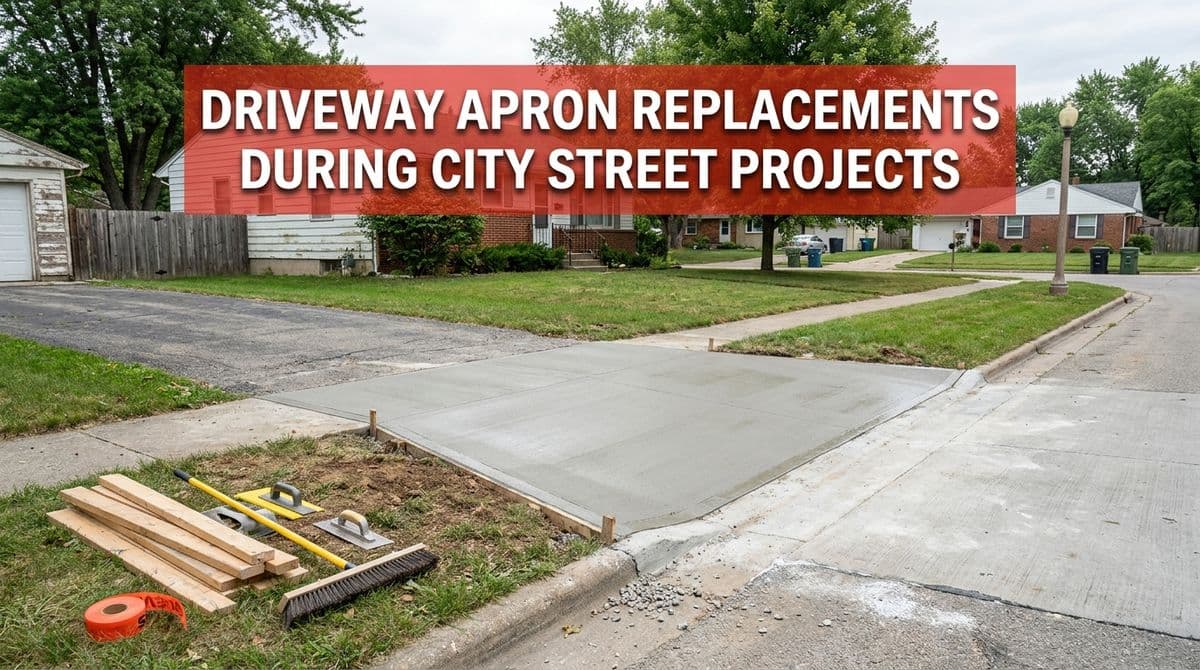
The driveway apron is the section of concrete that connects your driveway to the city street. When the city rebuilds or resurfaces the road, crews often need to remove all or part of this apron so they can:
- Adjust the height/slope between the new street and your driveway
- Replace curb and gutter sections
- Fix drainage issues at the bottom of the driveway
In many projects, the city will replace only the portion they disturb, and they’ll typically bring the apron back to a basic, functional condition that meets their specifications. That’s fine for some homeowners, but others see it as an opportunity to:
- Upgrade to thicker or better-quality concrete
- Fix existing cracks or sunken areas just beyond the city’s cut line
- Change the look or layout of the apron or entire driveway
City’s Contractor vs. Your Own Concrete Company
One of the biggest questions Brian’s cul-de-sac had was whether to rely on the city’s contractor or bring us in as their own concrete company. Here’s how we usually help people think it through.
Pros of Using the City’s Contractor
- Simpler coordination: The city manages scheduling and access to the site.
- Lower up-front hassle: You may not need to line up separate estimates or contracts.
- Basic match to street work: The apron will be integrated with the new curb, gutter, and road elevation.
Cons of Using the City’s Contractor
- Limited control: You usually don’t get a say in mix design, thickness beyond the spec, or finish upgrades.
- Patchwork look: They may only replace a small portion, leaving old cracked concrete right next to brand new.
- Less customization: Decorative finishes, changes in layout, or full driveway replacement are usually outside the city’s scope.
Pros of Hiring Your Own Concrete Company
- More options: We can do anything from a small apron patch to a full driveway replacement.
- Better integration: We can tie new concrete into your existing slab structurally (more on that next).
- Upgrades: Thicker slab, higher psi concrete, decorative finishes, or a new layout are all on the table.
Potential Downsides of Going Private
- Separate coordination: We need to coordinate around the city’s schedule, access, and any permits or inspections.
- Out-of-pocket cost: You may pay more than the basic apron patch included in the city project, depending on what you choose.
How Partial Driveway Apron Replacements Actually Work
Brian’s neighbors were especially interested in just replacing the apron section that would be disturbed by the city. That’s a very common scenario, and it doesn’t mean the whole driveway has to go.
Doweling Rebar Into Existing Concrete
When we do a partial apron replacement, we typically:
- Cut back to solid concrete: We sawcut the driveway at a clean, straight line where the existing concrete is still sound.
- Drill and dowel: We drill holes into the edge of the existing slab and dowel rebar into it.
- Tie the new rebar in: We connect that doweled rebar to a new rebar grid in the replacement apron section.
- Pour and finish new concrete: The new pour cures and essentially becomes part of the original driveway.
This method helps the new apron and the old driveway move together and reduces the chances of separation or a visible step forming at the joint.
What About Asphalt Driveways?
In Brian’s cul-de-sac, at least one neighbor had an asphalt driveway. We don’t install asphalt, but we can often pour a concrete apron that transitions to an existing asphalt driveway, or the homeowner can choose that time to switch to a full concrete driveway. Either way, it’s a good moment to think about long-term plans for the driveway, not just the apron.
Rough Cost Factors for Apron and Driveway Work
We’re always cautious about quoting “per square foot” numbers without seeing the site, but there are some common cost drivers you can expect when you’re comparing city work to a private contractor:
- Size of the replacement: Just the apron, apron plus a few extra feet, or full driveway.
- Thickness and reinforcement: Heavier vehicles or problem soils may call for thicker concrete and more rebar.
- Access and tear-out: How hard is it to remove the old concrete and get equipment in and out?
- Finishes and upgrades: Broom vs. decorative, colored concrete, or special edging.
- Timing with city work: Coordination around the street contractor’s schedule can affect mobilization and costs.
With Brian, we started by putting together a detailed quote for his full driveway so he could share it with neighbors as a reference point. From there, they could roughly estimate what a smaller apron-only section might cost by comparing square footage and then decide who wanted a formal estimate.
How HOAs and Cul-de-Sac Neighbors Can Coordinate
Brian didn’t want every neighbor to have to reinvent the wheel, but he also didn’t want to over-manage the process. We worked out a simple approach that might help your HOA or cul-de-sac do the same.
Step 1: Use One Detailed Quote as a Baseline
We created a clear, itemized quote for Brian and recorded a short video walking through what was included. He shared that with interested neighbors so they could understand:
- Scope of work (full driveway vs. apron only)
- Concrete specs and thickness
- Reinforcement and joint details
- Approximate cost per square foot, just as a rough proxy
Neighbors then measured their own driveways or aprons with a simple tape measure to get a ballpark idea of cost before requesting individual estimates.
Step 2: Schedule One Site Visit for Multiple Homes
Instead of having us make five or six separate trips, Brian helped coordinate one day for estimates. We walked the cul-de-sac, measured each interested driveway, and noted who wanted:
- Apron-only replacement
- Apron plus a little more
- Full driveway replacement
We then prepared individual quotes for each home. If the homeowner was home, we talked through options on the spot; if not, we followed up with written quotes and explanatory videos.
Step 3: Ask About Group Discounts
Because we were already on site for multiple driveways, we were able to discuss a multi-home discount. When we can:
- Mobilize crews and equipment once
- Order materials in larger quantities
- Pour multiple driveways or aprons in the same window
it often lowers our overall costs, and we can pass some of that savings on to the group. The exact discount depends on how many neighbors sign on and the total scope, but it rarely hurts to ask.
Making the Most of a City Street Project
City street projects can feel disruptive, but they’re also a chance to upgrade a driveway that’s already on your to-do list. As you plan, we recommend that you:
- Find out exactly what the city will and won’t cover on your apron.
- Decide whether you want basic replacement or an upgrade.
- Coordinate with neighbors or your HOA for shared site visits.
- Ask about group pricing if several homes are interested.
If your street is on the city’s project list and you’re unsure what to do with your driveway apron, we’re always happy to walk the block, answer questions, and help you and your neighbors choose the option that fits your goals and budget.