Switching From Asphalt to Concrete: Driveway Guide
Thinking about switching from an old asphalt driveway to concrete? Learn what really matters with base prep, installation, cost, and long-term maintenance.
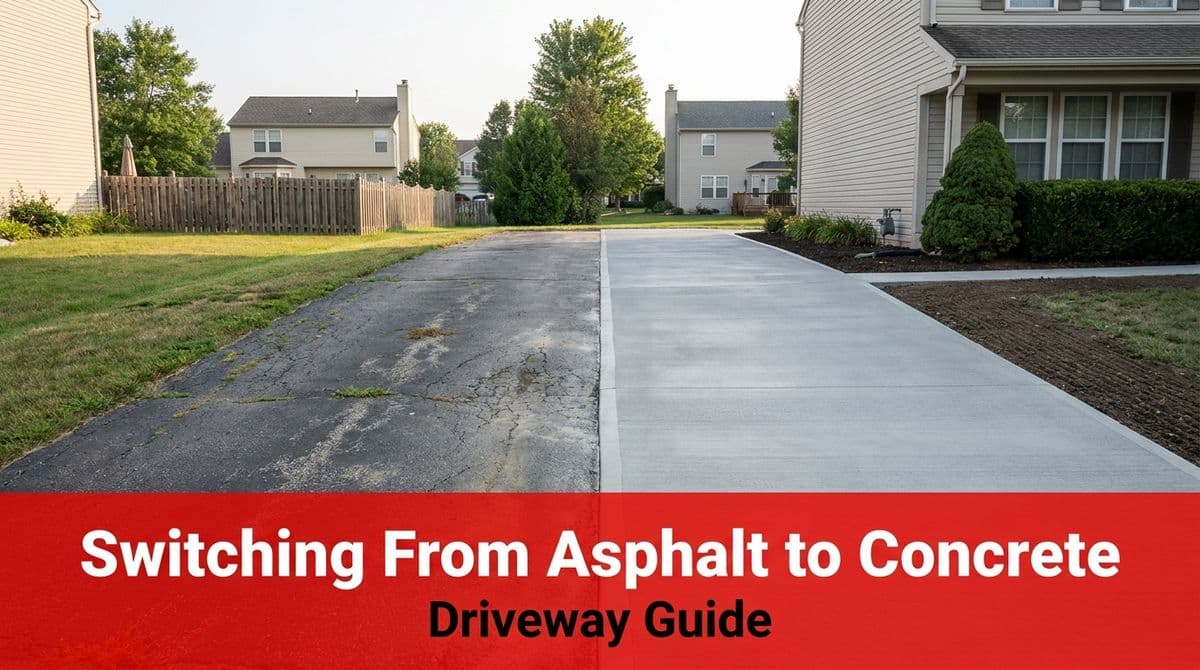
Thinking About Replacing Asphalt With Concrete?
We recently got a call from a homeowner — let’s call him Jake — in a neighborhood where we had just finished a concrete driveway for his neighbor. Jake’s asphalt driveway had been there for about 20 years, and Minnesota’s freeze-thaw cycles had finally taken their toll: cracks, dips, and constant patching.
His plan was simple: “I just want to switch to concrete and have little to no maintenance. I’ve never bought a concrete driveway before, so I have no clue what it should cost or what I should be asking.”
We have this exact conversation a lot, especially with folks moving from an old asphalt drive to their first concrete driveway. So in this post, we’ll walk through what we explained to Jake: what changes when you switch from asphalt to concrete, why base prep matters so much, and how to think about long-term maintenance and budget.
Asphalt vs. Concrete: What Really Changes for Homeowners?
When we meet a homeowner like Jake, the first thing we clarify is what they can realistically expect from concrete compared to asphalt.
Concrete driveways typically offer:
- Longer lifespan – When properly installed, a concrete driveway can often last 30+ years, especially with good base prep.
- Less frequent maintenance – No regular sealing like asphalt. You mainly want to keep it clean and seal the joints every so often.
- Better performance in heat – Concrete doesn’t get soft in the sun like asphalt can.
- A cleaner, brighter look – It can really freshen up curb appeal and reflect more light at night.
The trade-off is that concrete is more sensitive to how it’s installed. With asphalt, you can sometimes “get away with” weaker base prep for a while. With concrete, poor base work will show up as cracking, heaving, or settling much sooner. That’s why we spent a lot of time with Jake talking not just about the slab he’d see, but the unseen layers underneath.
Why Base Prep Matters So Much (Especially in Minnesota)
On Jake’s call, we explained that we’re usually not the cheapest bid because of how seriously we take base preparation. In our area, we routinely replace 6–8 inches of base under a driveway. That raised an eyebrow for him, and it does for a lot of homeowners.
Here’s what that actually means in practice when you’re replacing asphalt with concrete:
- Remove the old asphalt and any unstable base – We don’t just lay concrete over whatever is there. Old, soft, or organic material has to go.
- Rebuild the base with quality aggregate – Typically a well-graded gravel or class 5 material, compacted in layers to the proper depth (often 6–8 inches).
- Address drainage and slope – We make sure water runs away from your house, garage, and walkways so it doesn’t sit under the slab.
- Compact, compact, compact – This is where a lot of “too-good-to-be-true” bids cut corners. A poorly compacted base may look fine on day one, but it won’t stay that way.
In Minnesota, we have frost-susceptible soils and big freeze-thaw swings. If the base isn’t thick enough or properly compacted, you’ll get movement under your slab, which leads to cracks, lifted sections, or settled tire paths. Jake really appreciated understanding that most of the long-term performance of his new concrete driveway depends on work he’ll never actually see.
Our Concrete Mix and On-Site Oversight
Another thing Jake asked was, “Isn’t concrete just concrete?” Not exactly. Over the years, we’ve learned which combinations of materials hold up best in our climate, so we don’t just call in a generic mix from anywhere.
For every driveway, we:
- Use a high-quality concrete mix that’s designed for our freeze-thaw conditions.
- Stick with a consistent recipe that we know performs well, rather than switching suppliers and mixtures all the time.
- Have our foreman (and co-owner) on every job site to oversee the pour, finishing, and curing practices.
Jake liked knowing that the same person who came out to measure and bid his driveway would be the one leading the crew in his yard. It means the plan we discussed at his estimate actually gets carried out on site.
Typical Timeline and What to Expect During the Project
Jake also wanted to know, “If you come out Friday for the estimate, how soon could the work start, and how long will I be without a driveway?” While schedules vary by season, here’s a typical timeline for a driveway replacement once you approve the quote:
- Estimate & quote: We come out in the evening for measurements and discussion (usually between 4 and 7 p.m.). It often takes a few days to put together a detailed, line-item quote.
- Scheduling: Once you approve, we lock in your project dates based on our current workload and weather.
- Demo & base prep (1–2 days): We remove the old asphalt, excavate as needed, and rebuild the base with proper compaction.
- Pour & finish (1 day): We place the concrete, finish it, and cut control joints.
- Curing time: Light foot traffic is usually okay after a day or two; vehicles typically need to stay off for about a week, depending on conditions.
We always communicate the plan clearly so you know when you’ll have limited access and how to park vehicles during that week of curing. For many homeowners, just understanding the sequence makes the whole process feel much less stressful.
Common Mistakes When Switching From Asphalt to Concrete
When you start collecting bids, it’s tempting to focus on the bottom-line number. We encouraged Jake — and we encourage you — to ask a few key questions so you’re really comparing apples to apples.
Watch out for these common mistakes:
- Choosing by price alone – A cheaper bid that skimps on base depth or compaction can cost you far more in repairs down the road.
- Not asking about base replacement – “We’ll use what’s there” is a red flag, especially in areas with poor or unknown soils.
- No mention of mix design – If a contractor can’t tell you what kind of concrete they’re using for driveways in your climate, that’s worth questioning.
- Skipping clear communication – You should know who will be on site, how long the job will take, and what you’re responsible for (like moving vehicles or landscaping).
The goal is to invest once in a driveway that’s going to serve you for decades, not pay for “cheap” work two or three times.
Long-Term Maintenance: “Little to No” Doesn’t Mean “None”
Jake’s main hope was “little to no maintenance,” and that’s very realistic with concrete — as long as you take a few simple steps:
- Avoid de-icing salts the first winter – Use sand for traction instead, especially in that first season.
- Seal joints periodically – Keeping water out of the joints helps minimize freeze-thaw damage.
- Keep it clean – Rinse off oil, fertilizer, and other chemicals so they don’t stain or degrade the surface.
- Watch heavy loads – Occasional delivery trucks are fine; repeated heavy equipment traffic is not ideal.
Compared to the resealing, patching, and resurfacing that older asphalt often needs, most homeowners find concrete maintenance very manageable. It’s more about protecting your investment than constantly fixing it.
Considering the Switch? Here’s Our Best Advice
If you’re in the same spot as Jake — staring at a worn-out asphalt driveway and wondering whether concrete is worth it — our advice is simple:
- Get multiple quotes, but dig into what’s included in base prep and materials.
- Ask questions about mix design, base thickness, compaction, and who will actually be on site.
- Think long-term about lifespan, maintenance, and how your driveway will handle freeze-thaw cycles.
When you understand what goes into a quality concrete driveway, it’s much easier to see why some bids are higher — and why they often end up being the better value over the life of your home.
If you’re ready to explore replacing your asphalt with concrete, we’re always happy to come out, walk your property with you, and put together a detailed, no-pressure estimate just like we did for Jake.